
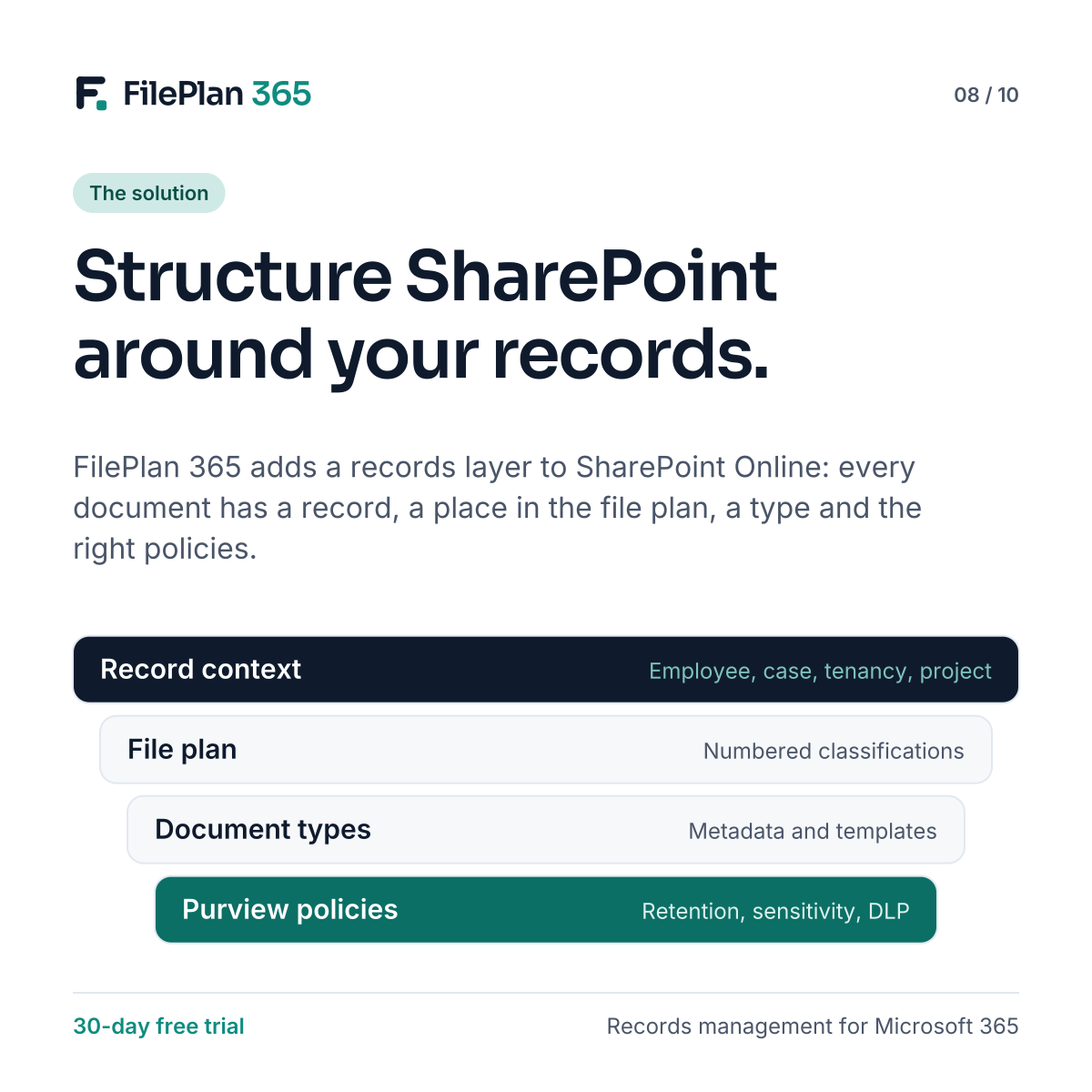
The problems in this series, from sprawl and duplicates to empty metadata, poor retention and noisy search, share a root cause: SharePoint has storage, but no records structure. FilePlan 365 adds that structure in four layers.
Layer 1: Record context
The foundation is the record your organisation manages: an employee, a case, a tenancy, a matter or a project. Every document belongs to one.
Record contexts hold the key metadata, such as names, references, dates and owners, and link to related records. They answer the question “what is this about?”
Layer 2: File plan
Within each record, documents are organised by a numbered file plan. For an employee, that might be 01 Recruitment and onboarding, 02 Contract and terms, 03 Right to work and vetting, and so on.
The file plan is the same for every record of that type, so everyone knows where things go, and where to find them.
Layer 3: Document types
Each classification contains defined document types, such as Employment contract or Gas safety record. A document type sets the extra metadata, templates and rules for that kind of document.
Document types are what make filing consistent and search precise.
Layer 4: Purview policies
Finally, each document type maps to your Microsoft Purview policies: a retention label, a sensitivity label and the DLP policies that apply. These are applied automatically when a document is filed, and retention can start when the record’s events happen.
How the layers work together
| Layer | Answers | Example |
|---|---|---|
| Record context | What is it about? | Employee: Priya Shah |
| File plan | Where does it belong? | 02 Contract and terms |
| Document type | What kind of document is it? | Employment contract |
| Purview policies | How must it be governed? | 6 years after leaving, Confidential: HR |
Put together, the four layers turn SharePoint Online into a records system that’s consistent across every site and team, without replacing the tools people already use.
Try FilePlan 365 free for 30 days
Every feature, in your own Microsoft 365 tenant.